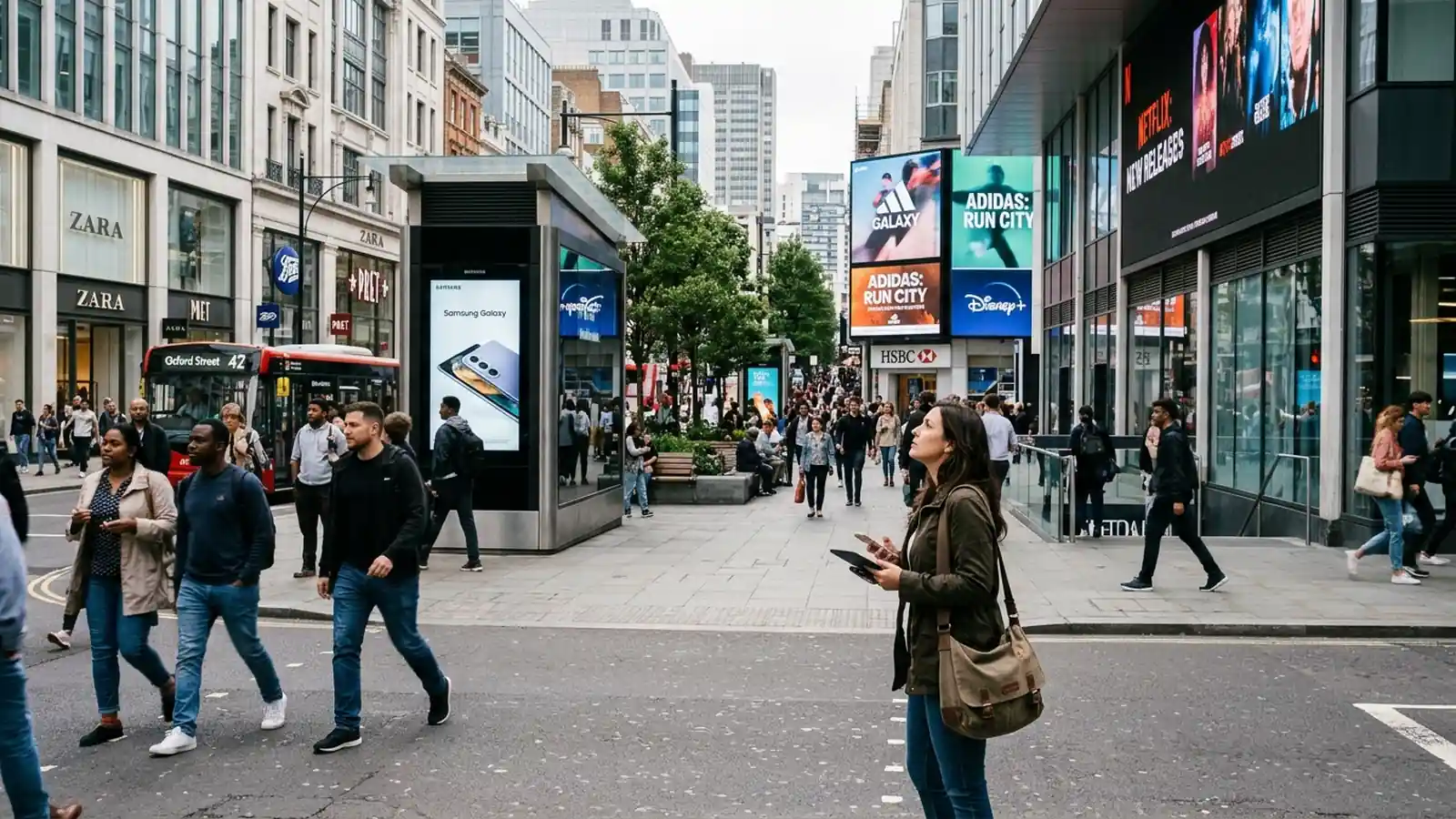



Connected TV and digital out-of-home are often planned by different people, on different platforms, against different goals. CTV sits in the video budget and DOOH sits in the out-of-home line. Yet both are screens, both can be bought programmatically, and both reach audiences that overlap in useful ways. Planning them together is becoming a common request from brand teams.
In short: DOOH and CTV work well together when each has a defined job. CTV delivers longer video to people at home, with a more attentive audience and household-level targeting. DOOH reaches the same people when they are out, often closer to the point of purchase. Good planning sets a shared frequency cap across both, sequences messages so they build on each other, and measures the combined effect against a control group instead of reading each channel on its own.
1The Different Jobs of CTV and DOOH
CTV is watched in the living room, usually on a large screen with sound. It suits a story: a launch film, a product demonstration, a brand message that needs time. Targeting is based on household or device data, and inventory is available through supply platforms, streaming services and demand platforms such as The Trade Desk and DV360.
DOOH is seen away from home, for a few seconds at a time, in a setting that can be matched to a place or a moment. It suits a reminder, an offer or a call to visit. Our guide on DOOH versus pDOOH covers how the buying methods differ. The two channels complement each other because one builds understanding and the other prompts action near the store or venue.
There are differences in attention too. A viewer at home may be watching with the sound on and fewer distractions, but may also be using a phone at the same time. A person passing a screen is giving only a glance, but may be a few minutes from a purchase. Neither is better in every case, which is why the plan should state what each channel is expected to deliver rather than assuming they are interchangeable.
Budget size changes the approach. A small budget is usually better concentrated on one channel in a limited area than spread thinly across both. A larger budget can support CTV for reach and DOOH for local presence, each with enough weight to be noticed.
2Planning DOOH Alongside CTV
Start with one objective and one audience definition, and apply both to each channel. If the goal is store visits for a grocery brand, CTV can build awareness among target households while DOOH covers the screens around the stores. If the goal is a product launch, CTV can tell the story and DOOH can reinforce it in high-traffic areas.
Budget is the next question. Rather than splitting by tradition, split by the job each channel does and by what each can deliver in your target area. A short test with both channels active, then a review of what each contributed, is more useful than a debate in advance. The programmatic DOOH advertising page explains how we plan DOOH buys, and retail media CTV and streaming covers the video side.
It is also worth deciding early where the audience definition comes from. If CTV targeting uses first-party or retailer data and DOOH uses location and venue types, the two audiences will not match exactly. That is acceptable, but note the difference in the plan so that results are interpreted correctly. For retail brands, retailer audiences can often be used on both channels, which is one reason these combined plans appear in offsite retail media discussions.
3Frequency Across Two Channels
Frequency is the hardest part of combined planning. CTV platforms can cap exposures per household, and some can cap per device. DOOH cannot cap per person in the same way, because screens are shared and anonymous. The usual approach is to set a CTV cap that suits the message, then use DOOH as a layer of reminders that you manage by area and time period rather than by individual.
Where the same households are known on both channels, for example when a retailer or data partner can match them, frequency can be managed more closely. Most campaigns will not have this, so the practical answer is to be conservative: moderate caps on CTV, wide rotation on DOOH and regular checks of delivery by area. If a campaign is small, avoid splitting it across too many markets, as thin coverage in each place weakens both channels.
- Set the CTV cap first, based on creative length and the audience size.
- Use DOOH delivery windows to avoid saturating a small area with the same creative.
- Rotate creative on both channels so the same shopper does not see an identical message repeatedly.
- Check delivery weekly and move spend if one area or audience is over-served.
Perfect cross-channel frequency control is not available today without a shared identity layer, so be honest with stakeholders about what is controlled and what is estimated.
4Sequencing: Which Goes First
There is no single correct order, but there are sensible patterns. For a launch, CTV usually leads, because it introduces the product with a full video message. DOOH follows or runs in parallel, repeating the key line and pointing to where to buy. For a promotion with a short window, DOOH can lead in the days before the offer starts, with CTV supporting.
| Goal | Lead channel | Supporting channel | Message approach |
|---|---|---|---|
| New product launch | CTV | DOOH | Story first, then a short reminder with the retailer name |
| Time-limited offer | DOOH | CTV | Offer and dates first, video adds context |
| Store traffic | Both together | None | Same call to action, local detail on DOOH |
| Brand awareness | CTV | DOOH in key cities | Consistent look and sound across both |
Whatever the order, keep the creative recognizably connected. The same logo, colors, tagline and offer help a viewer link a screen on the street with a video seen at home.
5Creative and Trafficking Differences
The two channels have different technical needs. CTV needs video files that meet each platform's specifications and ad tags that pass quality checks. DOOH needs creative sized for each screen type, often in several aspect ratios, and sometimes without sound. Producing one master idea and adapting it, rather than treating each channel as a separate project, saves time and keeps the message consistent.
Plan the creative brief with both formats in mind from the first day. A video that works at home often needs reworking for a street screen: fewer words, larger product, clearer end card. The reverse is also true, since a still poster rarely tells a full story. Agree which elements must stay fixed across both, such as the logo, the product shot and the offer, and let the rest adapt to the screen.
Think about the end of the journey as well. A viewer who sees the CTV spot and then a screen near the store should find the same offer at the shelf. Check that stock, pricing and promotion dates match what the creative says, and brief store or retailer teams where the campaign depends on them. Mismatches between advertising and the shop floor waste the attention the campaign has earned.
Finally, think about what happens if one channel under-delivers. CTV supply can tighten around major events, and DOOH inventory in a given area can be limited. Agree in advance whether budget moves to the other channel, to a different area or is held back, so that decisions during the campaign do not stall.
A short weekly note covering delivery, frequency, creative rotation and any issues is usually enough to keep everyone aligned. It should state plainly what is known, what is estimated and what is still to be confirmed.
Trafficking errors on either side can waste spend quietly. Our CTV and BVOD trafficking checklist covers the video side, and the DOOH ad specs and creative guide covers the screen side. A single owner who checks both before launch reduces the chance of a mismatch.
6Measuring the Combined Effect
Measuring each channel separately will undercount the combination and may double count shared outcomes. A better design uses a control group that saw neither channel, a group that saw only CTV, a group that saw only DOOH and a group that saw both. The difference between these groups shows what each channel adds and whether the combination does more than the sum of its parts.
If four groups are too many for the size of the campaign, a simpler test still helps. Compare areas where both channels ran with areas where only CTV ran, and the gap gives a rough read on what DOOH added. State the limits of the comparison in your report, so that decision makers know how much weight to place on it.
Outcomes to compare include store visits, site visits, branded search and, for retail brands, sales at partner retailers. Retail clean rooms and panel providers can supply some of this data. Our DOOH measurement and attribution page and the guide to retail media measurement and clean rooms explain the options. Agree the design before the campaign begins, because it is hard to build a control group afterward.
Allow time for results to settle. CTV exposure at home and a store visit days later can be hard to connect, and DOOH location data can take time to process. Set a reporting date that allows for this, and avoid drawing conclusions from the first few days. Document any events that could distort the comparison, such as price changes, weather or competitor promotions, so the analysis can account for them.
7Running Two Channels Without Doubling the Workload
Combined campaigns create more moving parts: separate platforms, separate reporting and separate creative requirements. A single campaign management team that handles both can keep schedules aligned, catch errors early and produce one report. Whether you do this in-house or with a partner, set a regular review that looks at both channels at once.
If you are evaluating outside help, the guide to choosing a pDOOH campaign management partner lists the questions worth asking, and the pDOOH buying workflow shows what a well-run DOOH process looks like.