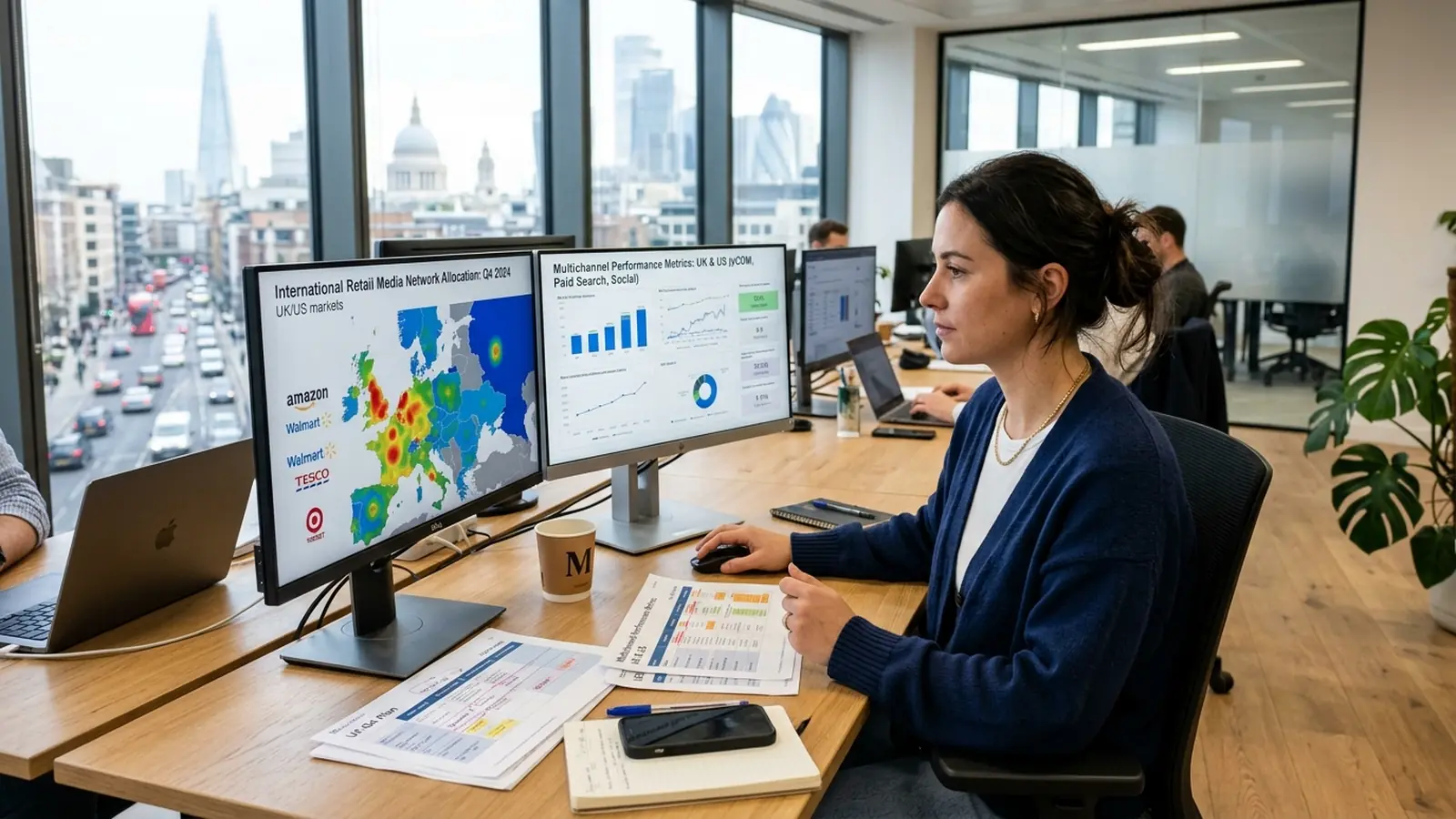



A few years ago, buying ads on a retailer's website was something a brand's sales team negotiated as part of a trade deal. Today it is a media channel in its own right, with its own platforms, its own specialists and a line in most brand marketing plans. If you have been asked to "do more with retail media" and aren't quite sure where the edges of it are, you are not alone. The term now covers search ads on Amazon, banners on a grocery app, video on a streaming service and screens at the end of a supermarket aisle.
In short: retail media is advertising sold by retailers and marketplaces that uses their first-party shopper and purchase data to target ads and measure sales. It comes in three layers: onsite (search ads, display and brand stores on the retailer's own site and app), offsite (retailer audiences used on other channels through retail DSPs, CTV, social and digital out-of-home) and in-store (screens and displays inside physical stores). What makes it different from other digital media is that the seller of the ad also sees the sale.
1What Retail Media Actually Is
A retail media network is a retailer or marketplace that sells advertising to the brands whose products it stocks. Amazon Ads, Walmart Connect, Instacart Ads and Target's Roundel are the best-known US examples. Grocery and pharmacy chains such as Kroger, Tesco, Carrefour and Coles run their own networks, and in India platforms such as Flipkart Ads, Blinkit, Zepto and Swiggy Instamart do the same. Some build the technology themselves; others license it from vendors such as Criteo.
The core idea is simple. The retailer already has shoppers on its site and in its stores, and it knows what those shoppers search for and buy. It packages that attention and that knowledge into ad products. For the brand, the appeal is that the ad runs close to the moment of purchase, and the result can be measured in sales at that retailer rather than in clicks or impressions alone.
2Why First-Party Purchase Data Matters
Most digital advertising relies on signals that suggest intent: pages visited, content watched, demographic estimates. Retail media relies on what people have actually bought. A retailer can tell you who bought your category last month, who bought a competitor's product, and who bought your product once and hasn't come back. That is a different quality of targeting from inferred interests.
The same data powers measurement. Because the retailer records both the ad exposure and the transaction, it can close the loop between the two, a setup usually called closed-loop measurement. Because browsers such as Safari and Firefox already limit third-party cookies, mobile identifiers are restricted by platform privacy settings, and consent rules limit data use, that direct link between ad and sale has become one of the main reasons budgets have moved into retail media. It is worth being clear about its limits, though: the retailer reports sales at its own store, not across all your channels, and attributed sales are not the same as incremental sales. Our guide to retail media measurement and clean rooms goes into that distinction.
3The Three Layers: Onsite, Offsite and In-Store
Each layer reaches the shopper at a different point, and most brands start onsite and add the others over time.
| Layer | Where it runs | What it includes | Notes |
|---|---|---|---|
| Onsite | On the retailer's own site and app | Sponsored product ads in search results and on product pages, sponsored brand ads with a logo and several products, display banners on the homepage and category pages, and brand stores that act as a mini-site for your range. | Where most brands start and where most spend still sits. Sponsored product ads behave a lot like search ads, so they need daily keyword and bid management; our sponsored products and search ads management covers that work. |
| Offsite | Beyond the retailer's own properties: the open web, connected TV, social apps and digital billboards | The retailer's audiences, so a brand can reach people who bought its category at a retailer, with sales still measured back at that retailer. | Usually bought through a retailer's own DSP, Amazon DSP, or partner platforms such as The Trade Desk. See how we run offsite retail media through retail DSPs, and our overview of retailer data on CTV, social and DOOH. |
| In-store | Inside physical stores | Screens at the entrance, in the aisles, on end-caps and at checkout, along with shelf-edge displays and kiosks. | The last touchpoint before the shopper picks a product, and increasingly sold and measured like digital media. Our in-store retail media service plans these screens alongside online campaigns. |
4How Retail Media Differs From Search and Programmatic
Retail media borrows mechanics from channels you already know, but the context changes how you use them.
| Question | Search engines | Open programmatic | Retail media |
|---|---|---|---|
| What drives targeting? | Keywords and query intent | Inferred audiences and context | Purchase history and shopping behavior |
| Where does the click land? | Your website | Your website or a landing page | A product page where the shopper can buy |
| What gets measured? | Clicks and tracked conversions | Impressions, clicks, modeled outcomes | Sales at that retailer |
| What else affects results? | Site experience | Creative and inventory quality | Stock, price, ratings and product content |
The last row matters most. In retail media, an ad can be perfectly built and still fail because the product is out of stock, priced above a competitor, or has a weak product page. That is why retail media sits closer to commercial and e-commerce teams than most media channels, and why digital shelf content belongs in the same conversation as the ads.
5Who Buys Retail Media
| Buyer | Who they are |
|---|---|
| Brands | Brands that sell through retailers, from large consumer goods companies to smaller direct-to-consumer brands that also list on marketplaces. Budgets often come from a mix of brand marketing, shopper marketing and trade budgets. |
| Agencies | Agencies that buy on behalf of brands, either inside a specialist retail or commerce team or as part of a wider media plan. |
| Marketplace sellers | Third-party sellers and distributors who advertise the products they sell on Amazon or Walmart Marketplace (or Flipkart, in India). |
On the other side are the retailers themselves, who need ad operations to package inventory, onboard advertisers and report results, in the same way a publisher does.
6Where Retail Media Goes Wrong Operationally
Most retail media problems are not strategy problems. They are operational ones that build up as a brand adds networks.
- Fragmented networks. Every retailer has its own platform, logins, ad formats and rules. A brand on five networks is effectively running five different media channels.
- Inconsistent creative specs. Banner sizes, file weights, copy rules and approval processes differ by network, so creative gets rejected and campaigns launch late.
- Reporting that doesn't line up. Networks use different attribution windows and different definitions of a sale, which makes side-by-side comparison misleading unless the data is normalized.
- Set-and-forget campaigns. Search campaigns left running without search term reviews, negative keywords or stock-based bid changes waste spend quietly.
- No plan above the networks. Budgets drift toward whichever network is easiest to spend on, rather than where the brand's shoppers actually are.
If you already buy on several networks, our playbook on running ads across multiple retail media networks covers how to bring them under one operating model.
7How to Get Started
Start with where your sales already happen. List the retailers and marketplaces that sell the most of your products, and check that your product pages there are in good shape: accurate titles, images, ratings and stock. Ads amplify a product page; they can't fix a poor one.
Next, set goals per network before setting budgets. A brand defending a category leader on Amazon needs different metrics from one trying to win new-to-brand customers on a quick-commerce app. Then begin with onsite search ads, which are the most direct link between ad and sale, and add display, offsite and in-store as you learn what each network can deliver. Our retail media strategy and planning work covers network selection, goals and budget allocation, and the wider retail media marketing services page shows how the onsite, offsite and in-store pieces fit together.
If you are already spending and want to know what is working, a structured audit is the fastest way to find out. Our retail media audit checklist shows what to look at, or you can request a free retail media audit and we will review your accounts with you.